

The role of corporates in VC ecosystem: an opportunity for scaling
As highlighted in the State of Italian VC 2024, Corporate Venture Capital (CVC) is emerging as a key factor in strengthening Italy’s innovation ecosystem. It is not just an alternative financing method but a strategic tool through which large corporations accelerate their transformation by investing in startups and emerging technologies. This allows corporates to access cutting-edge innovation while startups benefit from market.
In the article, we highlight key insights from three experts who joined us for a discussion on the role of corporates in VC ecosystem at the launch of the State of Italian VC 2024 report.
The CVC Landscape in Italy and Europe
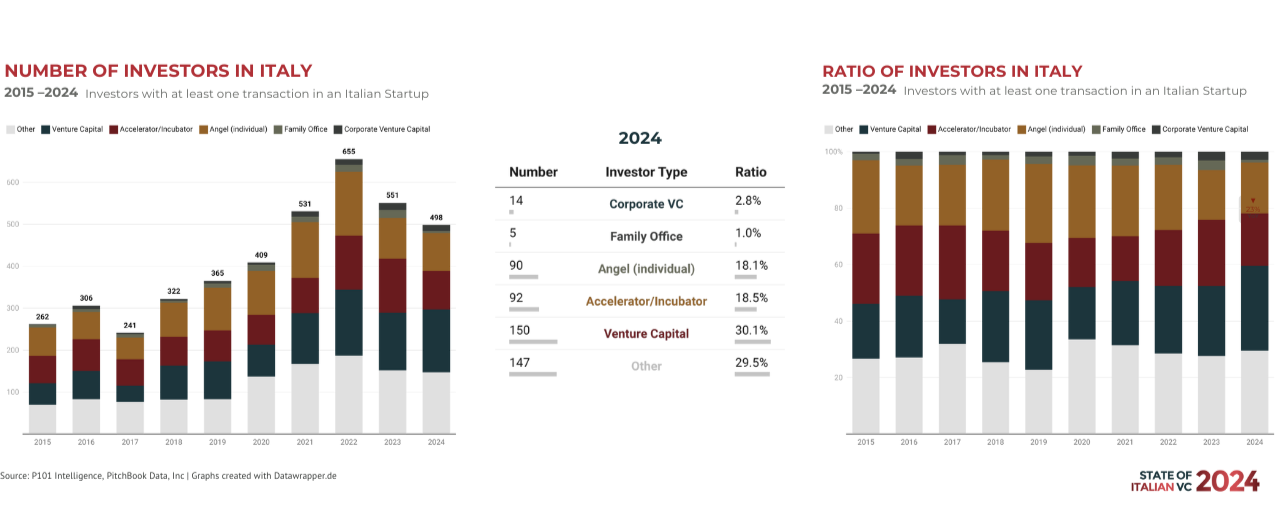
According to our latest report, CVC has grown steadily, increasing its share from 0.8% in 2015 to 2.8% in 2024, indicating a greater – though still limited – involvement of corporates in the venture capital ecosystem.
In terms of VC-backed startup exits, 2024 in Italy was dominated by corporates. Of the 27 exits, a significant 78% were M&A transactions, aligning with Germany and surpassing the European average of 74%. However, in absolute terms, Italy’s 21 M&A deals remain far behind Spain (31), France (108), and Germany (93).
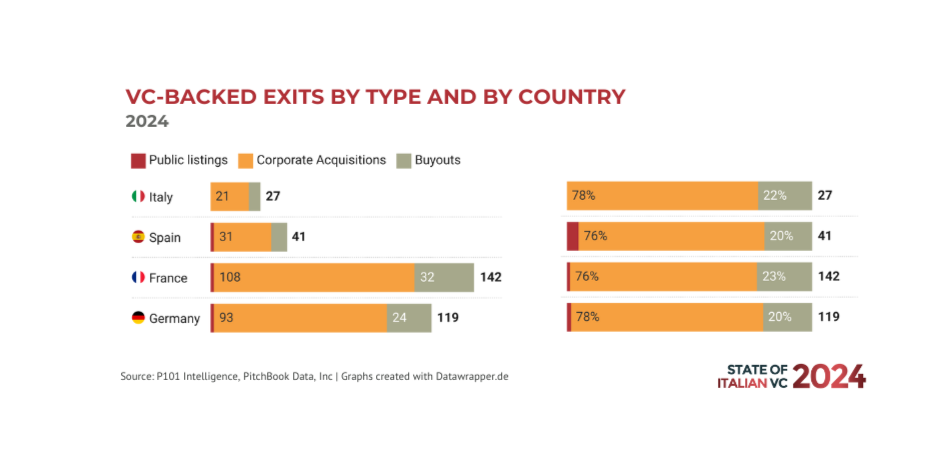 Moreover, corporate involvement in venture capital is still less structured and widespread compared to these more mature markets.
The Strategic Value of CVC and Alternative Collaboration Models
Several insights emerged from the conversation we held on the role of corporates in the VC ecosystem. Andres Sanchez Hontoria, Head of CVC at Mutua Madrileña, highlighted that corporate venture investing is now a well-established practice in Spain. He explained that many corporates in Spain are investing in companies and that the best way to evolve their business is through collaboration with new companies, strategies, and business models.
This approach could represent a strategic opportunity for many traditional companies in Italy, enabling them to remain competitive in an evolving market by integrating new technologies and business models.
However, CVC is just one of several models for corporate-startup collaboration. Beyond direct investments, corporations engage with startups through various approaches. Luca De Rai shared his experience with three different strategies to support startups at various stages of maturity. Corporates can contribute to proof-of-concept development by providing technical expertise, help scaling a startup’s business by integrating its technology into traditional processes, or leverage the company’s sales network to drive growth. One notable success story led to the creation of a new business unit within the company, born from a tech innovation developed in collaboration with university researchers. To replicate this success more systematically, they established a venture builder organization to strengthen collaboration with investors and better support startups in scaling.
Other common approaches include:
- Accelerators and Incubators: Corporate-backed programs that support early-stage startups through mentorship, funding, and resources, helping them refine their business models and accelerate product development.
- Strategic Partnerships: Long-term collaborations where corporations and startups co-develop products, enter new markets, or share technologies. These partnerships help corporates stay ahead of industry advancements while offering startups credibility and distribution power.
- Acquisitions and Acquihires: Corporations acquire startups to integrate their technology or talent, securing competitive advantages and accelerating innovation cycles.
- Open Innovation and Call4Startups: Large corporations launch open calls for innovative solutions, inviting startups to propose and develop new ideas. This model fosters a collaborative ecosystem, allowing corporates to tap into external innovation while providing startups with direct business opportunities.
Each model requires a careful balance to ensure startups maintain their agility while benefiting from the resources and market access that corporations provide.
Key Collaboration Challenges
While CVC presents significant opportunities, it also comes with challenges. One key issue is integrating startups into corporate ecosystems without stifling their innovation under rigid organizational structures. Giovanni Giuliani, former CEO of Zurich Italia, emphasized the need to protect startups from the corporate environment at the beginning. He warned that without this protection, startups risk being destroyed quickly.
One approach to overcoming these challenges is through startup-friendly procurement initiatives. Traditional corporate procurement can be too slow and rigid for startups, creating obstacles to collaboration. Some companies have already adopted more flexible supplier agreements, reducing onboarding times and increasing adaptability to better integrate startups into corporate supply chains. This not only accelerates partnerships but also allows startups to generate real business traction beyond just securing investment.
Another challenge for corporations is accessing and attracting startups. Giuliani pointed out that corporations are not primarily focused on startups or venture capital but rather on innovation. One effective model to overcome this challenge is collaboration between traditional VC funds and corporates. While corporates provide deep sector knowledge and market access, VCs bring the ability to scout, assess, and support startups in ways that align with their fast-paced nature. Sanchez Hontoria stressed that CVC should integrate with VCs to leverage their expertise in identifying and scaling startups. He mentioned that their organization has its own fund of funds to invest in VCs and collaborates closely with them to understand market trends and opportunities.
This synergy ensures that corporates can access disruptive innovation while startups gain the strategic industry insights necessary to scale successfully.
Despite its potential, corporate-startup collaboration can be slow. On average, it takes 18 months for large companies to go from initial interest to an established partnership with a startup. Key barriers include the absence of dedicated innovation units, rigid processes, and difficulty identifying the right startup partners. Compared to building or investing in a startup, strategic partnerships offer an immediate impact, but they require streamlined processes and internal alignment to succeed.
Conclusions
Corporate Venture Capital is playing an increasingly pivotal role in shaping the future of the venture capital ecosystem, not just as a financing tool but as a catalyst for broader growth. By fostering strategic partnerships between large corporations and innovative startups, CVC creates a symbiotic relationship that accelerates technological advancements, drives market expansion, and enhances the competitive edge of both corporates and startups.
For the startup ecosystem, CVC provides not only the capital needed for scaling but also access to market validation, resources, and operational expertise that are critical for long-term success. In turn, corporates gain early access to disruptive technologies and fresh business models, enabling them to stay ahead of industry changes and drive their own transformation.
In Italy, where the CVC landscape is still evolving, strengthening corporate involvement in venture capital can serve as a bridge to a more dynamic and interconnected innovation ecosystem, benefiting all stakeholders and driving Italy’s position as a key player in the global innovation landscape.
#Inside SoIVC will continue to explore the most relevant trends in the Italian venture capital market, providing insights and data to guide investors and companies toward a more innovative and sustainable future. Stay tuned for updates!