

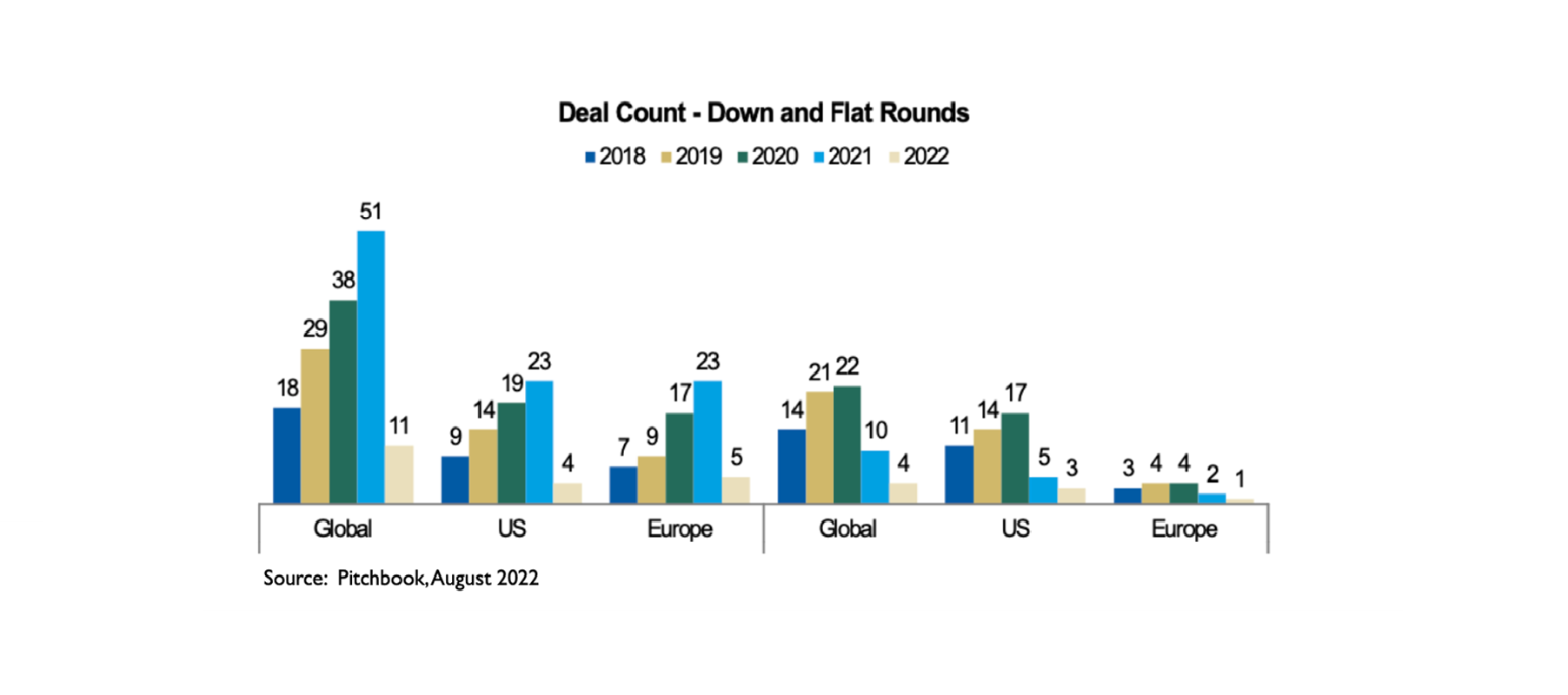
2022 could not be a good year for Fintech in Europe… but it could be worse. In fact, despite some big down rounds, such as Klarna’s, only few down or flat rounds have been counted to date:
What is next?
According to Morgan Stanley’s analysts, private markets usually suffer from public downturns 18 months later, on average, and therefore a trough in valuations is expected to show in July 2023.
Hence, private markets may have 10 further months of downturns or smaller funding rounds ahead, as VCs will become more selective, and founders won’t raise dilutive rounds.
On the other hand, there is a lot of dry powder (aka money) that must be somehow allocated especially by all the funds that have raised money in the last 10 months and that have decided to slow their investments down to see what turn the macroeconomic scenario will take. But if Morgan Stanley’s analysis is true, which is likely, these funds cannot wait 18 months and then start investing massively: they would not respect their investment period schedule (agreed with the LPs) since they would not have the time to make the necessary money deployment.
Where can VCs invest?
As a fund, we must understand and intercept future trends, analyzing fintech sectors that are currently overperforming the industry, despite all the macroeconomic scenarios:
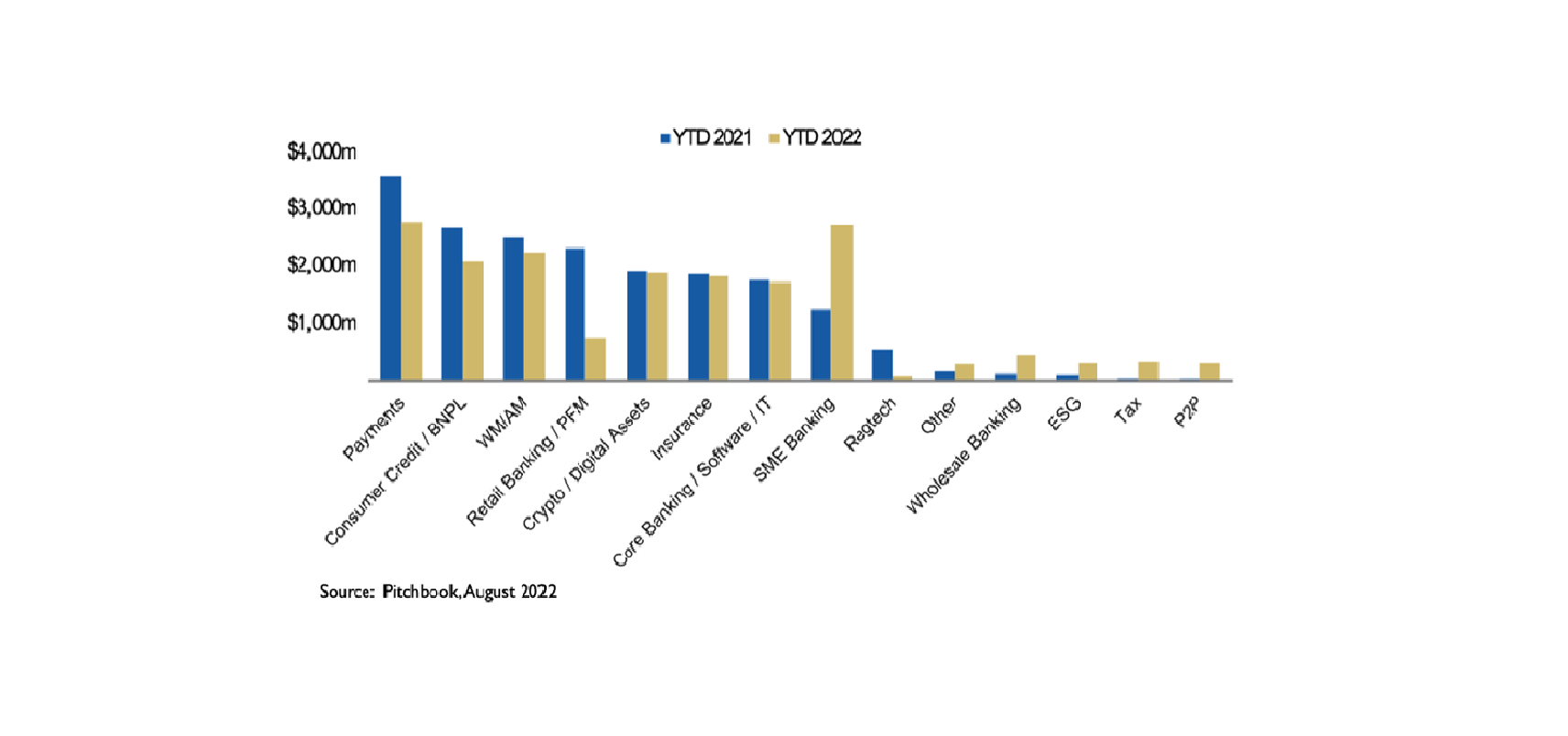
SME Banking is the sector that has seen the most increase in funding in 2022, by far. Payments is still something hot as BNPL, but less than in 2021.
Why invest?
More and more SMEs are looking into embedded finance to decrease frictions with incumbent banks. According to a 2021 research by Accenture, based on a panel of more than 2,5k SMEs around the globe (especially Europe and the US):
- 41% of SMEs would be interested in using banking services from a digital service provider. A percentage that reaches 52% as businesses get larger (50-250 employees);
- 44% of SMEs prefer digital platforms to offer services in partnership with traditional banks. A number that falls to 30% as businesses get larger;
- 47% of SMEs would be willing to consider a premium price for embedded finance services. A portion that grows to 57% as businesses get larger.
It will be more and more fundamental for companies to get an extra revenue line (brokerage margin) by providing financial services to their supply chains, as if they were a bank. In this way they could increase margins and allow suppliers to be financed, for example, through plain lending or advance invoices, with interest rates that are currently just a few basis points above banking ones, helping them to overcome turmoils in a faster and simpler way.
For instance, among our portfolio companies is a leading embedded finance player, Opyn. This company is known for offering Banking as a Service (BaaS) products and supply chain finance. It gives SMEs a complete suite of tools from which they could both borrow money and also be lenders, according to their needs.
AI platforms and Saas business
Besides AI platforms that speed the credit process up and are super-interesting opportunities for SMEs, there are other fintech spaces for SMEs leading us into temptation, i.e., SaaS businesses:
- Risk management tools: so far there’s nothing for SMEs that could resemble a risk management function, as the one that all VC funds must have, with the result that lots of companies don’t know who they are working with, its financial stability, etc… with all the implications;
- Cybersecurity solutions that deal with fraud prevention & biometric access and protection;
- Tools for improving Financial Institutions’ KYC procedures.
Financial Institutions love SaaS and AI Fintech businesses because they have these features:
- Cost Savings: no hardware equipment updates, no installations or traditional licensing burden;
- No need for internal team: responsibility of the SaaS provider;
- Many value-added services: issuing and acquiring integrations have already been done;
- Regular updates: which will translate as a continuous stream of innovation to the members of the ecosystem;
- International profile: easy to deploy wherever its needed and in real-time, easy overcoming cross-border problems;
- Always on track with the newest technological trends;
- High and automated security controls;
- Agility to support volatile business cycles and demand patterns.
Both SMEs banking and Embedded Finance are trends that we believe will grow much stronger in the near future: fintech companies that will provide the technology to fill these gaps will probably be unicorns in a few years.
Sources:
“Embedded finance for SMEs: the ultimate collaboration of banks and digital platforms” – Accenture 2021 (research on +2,5k interviews of SMEs in Italy, France, Germany, Spain, UK, US, Canada, Singapore, Australia, Brasil);
“The Fintech radar – Private versus Public markets, diverging trends” – Morgan Stanley, August 2022
Pitchbook, August 2022.
Keyless specialises in authentication and identity management solutions. Its story started in 2018 from the idea of Andrea Carmignani and Fabian Eberle. London was its first headquarter, an element that allowed the two entrepreneurs to build strong business relationships in San Francisco (USA) and to obtain their first fundraising.
Soon Carmignani and Eberle decided to bring their company back to Italy. P101, “Luiss” University, and Primo Ventures helped them in this process.
In 2021, Keyless closed a 3,000,000€ investment round. Previously, in July 2020, it had raised another round that was led by P101. Thanks to these two deals, the company gained 9,2 million dollars in total fundraising. Recently, Sift, a cybersecurity Californian company, backed by some tier 1 VC investors like Insight Partners, Union Square Ventures and Stripes, acquired Keyless. Today, the latter has 45 employees.
New risks and new needs
During the Covid pandemic, investments concerning technology and, especially, digitalisation increased. As a consequence, companies accelerated this transition to the digital.
In this regard, we can find interesting data in the ‘Global CEO Outlook Survey 2020’ by KPMG, the annual research involving 1.300 CEOs working in Italy and other ten leading global economies. This analysis shows that CEOs invested a lot in technology over the lock down period. They trusted in digital transformation to increase their companies’ resilience and flexibility and become more customer-focused.
This new trend brought more cybersecurity-related issues. Passwords are the first element that cybercriminals exploit to hack systems. According to the 2022 Data Breach Investigations Report by Verizon Business, stealing credentials was the most common form of hacking in 2021. It reached almost 61% in 2021 and 80% in 2020.
Keyless has the answer!
That is the mission of Keyless. The company came up with quite an extreme solution. It decided to eliminate passwords.
“We generate biometric cryptographic keys that have strict privacy features”, Carmignani explains. “It is an easy and safe solution that allows organisations to obtain a great conciliation between security, privacy, and benefits. We developed our system over 10 years of research. Replacing passwords with users, reduces complications concerning user experience and, also, eliminates the risks connected to human errors. Moreover, our solution does not depend on third parties. This means that it works with any platform, operating system, and user’s device”.
If we compared Keyless solutions with others on the market, we could notice that their main improvement concerns privacy.
“Our solution could seem to compete with Apple and Samsung systems that provide facial recognition for smartphones”, says Carmignani. “Nevertheless, facial and fingerprint recognition, systems we normally use to unlock our devices, are based on passwords too: they are the face or fingerprint that unlocks our device. Instead, Keyless creates a geometrical presentation of a user’s face from an image. This picture does not get stored because there is no need to do it. This procedure allows us to create a unique key that can be only used by one person. Furthermore, thanks to our decentralised cloud system, we can guarantee safety and anonymity”.
Luiss university was the first institution that tried this technology. Thanks to it, more than 1,000 students could take their exams from home thanks to a fast integration of Keyless with Cisco solutions. And all this happened in just a few weeks.
The technology behind Keyless
Keyless system is “multi-factor” by design. The user does not need to remember anything or utilise any additional tool (hard token, smart card). It is plug-in. You can integrate it with pre-existing systems and organisations without making changes to their security systems. This means that companies can offer this new service in a short time.
The technology underpinning Keyless is completely Italian. And we can say the same for the core elements of the company. During the development phase of this technology, the meeting with professors Giuseppe Ateniese and Paolo Gasti was essential. Ateniese is an associate professor of Computer Science at the University “Sapienza” in Rome, while Gasti works as a professor of Computer Science at the New York Institute of Technology.
Next steps
Keyless has clear plans for the near future. For its new projects, the keyword is “behavioural biometrics”.
Carmignani says: “Over the next three years, we’ll focus on behavioural biometrics: from facial geometry to behaviours – how I hold my phone, or I type on the keyboard. These parameters will be used to recognise any specific user”.
The company is also willing to establish business partnerships in new countries and expand its team.
“We will settle in our Sift headquarters, in San Francisco, and we will look for new markets”, reveals the CEO. “We will focus on the European Union, but also Israel, and United Arab Emirates. Keyless will continue to grow. Therefore, we are always looking for new talents with open minds and international spirits”.
Habyt is a German-Italian company that rents out different types of accommodations. The main targets of this service are not tourists, unlike Airbnb: its clientele are young professionals who need to live abroad for a long period of time.
Habyt was born in 2017. It was founded by CEO Luca Bovone, one of the first Dropbox managers in Europe together with a multifaceted and close-knit team. These Italian entrepreneurs were living in Germany when they came up with a plan for their start-up.
Habyt: how everything began
Everything started from personal experience. Bovone often needed to travel to different European cities for work. He discovered that to find available rooms or apartments for a medium period of time (six months or a year, for example) was not easy. Furthermore, he understood it was complicated to bargain with landlords in a different language, particularly for young and inexperienced people.
From the beginning, Bovone and its team wanted their service to be easy, entirely digital and with a standardised design. They thought that these features would help speed up the entire renting process. In addition, people would not need to use an intermediary.
Habyt started by managing 7 rooms in Berlin. Later, thanks to new funds, the start-up managed to export its business to Spain.
Soon, it caught the attention of angel investors such as Florian Swoboda (Caroobi, Movinga and Homebell) and estate investor Jakob Maehren. Thanks to them, the company raised 500,000 euros, approximately. Then, in November 2018, Habyt closed a third investment round, in which P101 funded the start-up for 2 million dollars. Over the following years, the company managed to close other important investments rounds. Thanks to the new funds, in 2021, Habyt also acquired the Milan-based start-up Roomie, that is specialised in co-living solutions and accommodations for students and young professionals. This was part of a project that aimed to double the presence of Habyt’s accomodations in Italy by the end of 2022.
Nowadays, Habyt has partnerships in 10 markets across Europe and the rest of the world. Berlin, Frankfurt, Hamburg, Munich, Amsterdam, Madrid, Barcelona, Lisbon, Milan, Turin, Singapore, Hong Kong and Tokyo are some of the cities involved in Habyt’s business. Now its clients can choose between 8,000 rooms and flats.
Habyt’s business
Habyt works in the PropTech market, which has recently seen a massive expansion in Italy. PropTech comprises all the digital services related to real estate, especially renting. According to the Italian PropTech Monitor (IPM), in 2021, there were 184 PropTech operative offices, 21% more than December 2020.
The IPM sorts PropTech companies by activity. There are 4 groups: Real Estate Fintech (27%), Smart Real Estate (19%), Sharing Economy (22%) and Professional Services (32%).
Over the next five years, big data, analytics and IoT will play a pivotal role in the real estate business. Also, blockchain will be very important, thanks to which, it will be possible to digitalise cadastral registries and have a complete record of every transition. Indeed, this technology allows to store information permanently.
How Habyt works
Habyt headquarters are in Berlin. The company’s core team manages everything related to technology and services, like sales and support. Furthermore, the company has a network of employees and contractors who curate its business in other countries.
Habyt does not possess the properties it rents. It works directly with the owners, through management contracts or long-term rents.
There are always several considerations behind the choice of new cities in which to expand Habyt’s business.
“We guarantee our business philosophy works in cities with more than 500 thousand citizens. Cities that are built around universities, scientific or economic centres”, says Bovone. “We select a location by examining data coming from internal analysis and information that are already available from external sources. For example, we use Idealista data to understand the type of demand there is in a specific area. From these numbers, we build a predictive financial model that estimates the chances that a room or flat has to be rented and its supposed price”.
The technology behind Habyt
Habyt developed its technology internally. This aspect has allowed it to maximise its effectiveness and minimise its costs.
A central system uploads the new vacancies (among the accommodations that are managed by the company) on platforms around the world. Also, Habyt’s technology automatically optimises the accommodations selling prices by considering their availability and the market request. In addition, clients can book their room or flat through the same platforms.
“All of this helps us optimise prices and employment rate, which is always over 95%“, explains Bovone.
Finally, the whole customer experience is digital and automated. This aspect guarantees a high degree of efficiency.
1000Farmacie is specialised in the home delivery of OTC medicine and drugs, which are those that do not need a prescription. Its system is based on a network of Italian pharmacies that make their products available on its platform.
The mind behind the entire project is a young entrepreneur, 29-years-old Nicolò Petrone. Before becoming CE0 of 1000Farmacie, he had founded Medici, a fintech marketplace that the American company Prove acquired in 2021.
Petrone created his new start-up together with two other entrepreneurs, Mohamed Younes and Alberto Marchetti.
Firstly, 1000Farmacie closed a 1.7-million-dollars round. Then, in February 2022, the company announced that its capital had increased by 15 million dollars. P101 SGR e HBM Healthcare Investments were the lead investors of the entire operation. Corisol Holding, Club degli Investitori, IAG, LIFTT and Healthware Ventures also invested in this new business.
1000Farmacie has reached a gross merchandise value of over 20 million dollars, on a yearly basis. Also, it keeps on reinforcing its partnerships with some of the major pharmaceutical companies in Italy. These companies chose 1000Farmacie to improve their delivery service.
1000Farmacie launched its business during the peak of the Covid pandemic
The story of 1000Farmacie began in March 2020. Petrone started developing an idea he’d had while living in the USA. He had moved there after his graduation in Economy at the University “Federico II” of Naples. In the USA, he had attended the Hult Business School in San Francisco.
That Petrone started thinking about e-commerce in the pharmaceutical sector when he was living in the USA is no coincidence, as the digital health market was already very developed there. According to him, the fact that in the USA they can sell prescription drugs online – an option that is still not available in Italy – helped this sector progress greatly.
However, the pharmaceutical business was becoming increasingly important in the European Union as well. And this, of course, was a pivotal element in the creation of the start-up. “In Europe, the pharmaceutical business had been growing massively, and we decided to enter the market”, explains Petrone.
While developing their new business, Petrone and his two associates considered another aspect. The Italian pharmaceutical market is very fragmented. It is characterised by independent pharmacies with no online platforms where they can sell their products. Furthermore, each of them has a limited variety of products.
Therefore, 1000Farmacie introduced to the Italian market a system that makes the inventories of many pharmacies available on a single platform. Thanks to that, it provides clients with a greater variety of products and a faster home delivery.
Over the last year, 1000Farmacie’s gross merchandise value has increased by 300%. Since its establishment, the company has formed a network of more than 100 independent pharmacies. Nowadays, 290,000 customers are using the platform, where they can choose amongst 95,000 products.
How does 1000Farmacie work?
When they were developing their start-up, Petrone, Younes and Marchetti understood that there were two business models they could employ. One was a pharmacy with stocks and a storage room. The other was something similar to a marketplace. They chose the second one.
“In the e-commerce business, costs related to logistics have a huge influence”, says Petrone. “Working with a pool of pharmacies involves fewer expenses because you rely on their logistics. This model becomes scalable, and it nullifies the risk of having unsold goods or products that are about to expire. On the other hand, you can still have an ample catalogue”.
“We have created a vertical integration with the pharmacies’ managements. It has been a complex process because the market is very diverse”, he adds.
Anyway, not every pharmacy is suitable for this type of business. “Our pharmacies need to have a wide workforce, since the amount of work may increase abruptly, and they might need more people and space right away to meet market needs”, explains Petrone.
Next steps
1000Farmacie is planning to expand its market. Until now, it has only worked in Italy, but the idea is to start new partnerships in other European countries too.
The company also wants to improve the e-commerce side of its business. Their aim is to speed up delivery times. In a few months, the start-up will activate a service that will guarantee delivery within 24 hours. In the beginning, this option will be available in the major Italian cities, then nationwide.
The new funds will be used specifically for the technological and commercial improvement of 1000Farmacie’s platform. This process will focus on finalising an innovative model for the online sale of pharmaceutical products.
1000Farmacie will develop in a similar way to Pillpack, the US company that Amazon bought for 1 billion dollars in 2018, in order to integrate its technology. In fact, Pillpack has developed an e-commerce business of pre-dosed and sorted meds. Before that, Amazon only sold OTC drugs.
Last but not least, 1000Farmacie will also introduce new services. For example, from 2023, clients will be able to ask for health support through its platform.
In Italy we have excellent start-uppers who have already created companies with solid business models and with the power to disrupt consolidated sectors. We are beginning to have companies with unicorn potential, which are also attracting international capital. In P101 portfolio, for example, Casavo and Opyn have started a growth path that has led them to sizable estimates.
There is a growing venture capital ecosystem, excellent human capital, ideas, but we are at least five years behind France, not to mention the UK, in terms of market development. It’s statistics: despite the exponential growth that the Italian VC ecosystem has experienced since 2018, our market is valued around 1 billion euros (projections 2021), while the German one is 2.5 billion euros and the French one 4 billion euros. (Then again, a comparison with the British context would be merciless for the core European markets too.)
And if much has been done to push companies towards the stock market – for example with the institution of an alternative market for small, high-potential, businesses called “Aim” – the matter of venture capital is still very quiet. In a complete ecosystem, like the US one, all the phases of venture capital (from angel investment, to seed, up to early and late-stage investments) must coexist and culminate in an IPO or a generic M&A in order to allow venture capital to exit the investment. And this concept is even more compelling for fintech companies.
Each link in the value chain must be in its place to make sure that the start-up won’t slow down halfway across the path of growth and that in each individual investment phase investors will want to enter a specific segment of VC financing. If I am a late-stage investor, I need to find investment opportunities that have already been backed by early-stage investors, but I also need to know that there will be a possible realization of my investment at a later stage, including a receptive and liquid IPO market.
What is still missing in Italy?
Do we have everything we need to push innovation in Italy? Finance, alone, is not enough. There are dozens of other issues to be considered, related to bureaucracy, the administration of justice, regulations, cultural approach. It must be said that the Italian venture capital scene is young – it’s less than 10 years old – and this partly explains the difference with Germany and with France – where the VC market has also been sustained from the State with several targeted actions and a systemic policy. To fill the gap in the value chain, a lot can be done in terms of government involvement and a lot has already been done by the main market players, especially the ones investing in the seed stage of companies (but something is missing still). On the VC side, the real absentee is the late-stage phase: there are few players that can make equity deals that are higher than 6-7 million euros and almost none above 10-15 million (the ones who can are not Italian operators).
Obviously, there is no harm in being financed by non-Italian operators: it is a global, open, and free market. But, of course, we must also have Italian players.
Our forecast is that within two years’ time we will be able to bridge this gap. But we must act strongly now, as we are having important exits, with valuable cash generation.
How can we act? We can initiate multiple factors: simplify regulatory and fiscal processes; increase the flow of capital to VC management companies, for example from insurance or pension funds (France is a good example in this sense).
A lot can be done also on the start-up front (and, to tell the truth, a lot has already been done). Founders must be ambitious, think internationally, give life to companies that effectively solve real problems, in an innovative and different way than competitors. They must approach venture capital as an effective partner of growth and not an end in itself.
Moreover, there should be a more active domestic stock market in terms of IPOs and resulting stock liquidity with a greater understanding of fintech (and tech in general) workings by brokers and equity research.
We need to have a whole ecosystem revolving around private capital as well as also public capital. And the latter must have a proactive and non-invasive role.
Team, business model or market?
As for fintech start-ups, the key elements for a VC fund are their management teams and founders. Assuming that the business model/market matrix is valid, our experience tells us that if management has a series of characteristics such as the ability to react to unexpected events, resilience, listening and dialogue skills, “risk-adjusted” ambition, then we have the right elements for VC to invest and for the company to embark on a successful path towards an exit.
Around the corner there will be many open challenges and surprises, in the post-Covid time that still needs to be imagined. According to McKinsey & Company, in 2020 European economies shrank by 11% on average, and the most updated estimates show that there will be no return to pre-Covid levels until 2023. In this context, traditional finance has been forced to a sudden change of perspective. It was widely known that digitization would be its near future, since the demand for smarter services by Millennials and Gen Z (the new bank customers) had been growing for years. However, as everyone has already noticed, social distancing has hastened this secular change. More and more traditional banks are interacting deeply with Fintech companies, and fintech companies are turning into new entities. The first movers of this evolution are, on the one hand, colossal challenger banks and, on the other, innovative traditional banks. They have a clear advantage.
In the near future, two main aspects will influence the scenarios of an increasingly intense collaboration between banks and fintech companies. First of all, Fintech companies are growing from small to medium size – and in this process they will have to abandon the start-up fail-fast method. At the same time, traditional banks will need to abandon legacy technologies to become more agile. Each side is going more and more towards the other, until they will merge. The bank that awaits us will be increasingly technological and digital. Concepts such as open banking, digital lending, API (Application Programming Interface) and PaaS (Platform as a Service) are and will be particularly interesting.
Digital native services and regulation are the advantages of Fintech
Meanwhile, 2020 has been a good year for financial technology overall. It’s true that the general slowdown of economy has had an inevitable impact on investments, which have been penalized by uncertainty and the rescheduling of all business plans. But despite all this, Fintech companies have capitalized on their advantage: i.e., offering digital native services and modifying their offer to meet the fluctuating needs of the market. This advantage was particularly strong in 2020, when customers had to access and manage their finances remotely, which is not always so easy to do with traditional financial institutions. Furthermore, the European regulation of crowdfunding is on its way: it puts lending and equity side by side and paves the way for new opportunities.
Public assistance and Brexit
LendIt asked some questions to Fintech operators that are based mainly in the United Kingdom (33%), Poland (13%), Italy (11%), and Germany (7%). It emerged that the most disruptive thing in 2020 was government intervention. First of all, there were anti-Covid aid plans, which have had a positive impact, since Fintech companies were able to lend state-guaranteed loans to the real economy. Fintech lending proved to be effective, as opposed to the bureaucratic delays of most banks, whose loans to SMEs too often arrived late. Furthermore, anti-Covid economic measures have been important for some Fintech companies, as they have spurred a skyrocketing increase in corporate lending. Others, however, found that, overall, these measures have been insufficient.
A further element of change is Brexit, which altered Europe’s financial equilibrium, shuffling the cards on the European Fintech table. It has probably created strong demand for data hosting and management solutions on both sides of the Channel, but it has also significantly complicated cross-border trade, not to mention that it presents regulatory challenges that have yet to be assessed.
Which Fintech companies are leading the innovation?
As for the companies that stood out in 2020, the Fintech ecosystem agrees that the podium goes to Revolut, the fastest growing challenger bank in Europe, which has received most financing at a higher valuation. But what is stunning is the pace at which it launches new products, both in the UK market and internationally.
In second place, Fintech companies suggest Starling Bank, another challenger bank that might reach the unicorn status thanks to its latest financing round. It is the only neobank that was started by an experienced former banker, and it would seem that its particularly careful management approach is paying off, since at the end of 2020 it had already reached its break-even point.
Finally, Klarna, the Swedish buy-now-pay-later giant, stands out among the Fintech leaders, as it is on the verge of another monster round that will bring its value between £25 and £30 billion. Its business in the United States adds one million new customers a month to the 90 million they already have around the world.
And which banks?
Some “traditional” banks have also embraced innovation. According to Fintech companies, the most innovative one is BBVA, that has been the leader of digital transformation in the last ten years. It launched its innovation hub in 2010, to interact with the Fintech ecosystem more easily, and was one of the first banks to invest in Fintech companies with its venture capital fund, Propel Venture Partners. Mastercard, too, is considered to be an innovator. In 2020, it launched Mastercard Fintech Express in Europe, to help Fintech start-ups leverage the Group’s extensive network of partnerships. Last but not least, when Goldman Sachs launched its Marcus brand in the summer of 2018, many wondered if it would be successful. Since then, aggressive savings rates have led 500,000 customers to deposit £21 billion. What is most impressive, however, is that it is reinventing itself from solid investment bank to innovative digital bank offering cutting-edge products.
Therefore, overall, the outlook is optimistic. Fintech companies keep growing geographically, they are developing new products and services, although they find that raising capital is becoming increasingly difficult. We believe that this obstacle will soon be overcome by the general need – of banks too – to accelerate the process of digitization. A this will very soon change the world of finance for good.
“Some say the Chinese have all the data and the Americans have all the money. But when I see what we have going for us here in Europe, I see that we have purpose”. European Commissioner for Competition Margrethe Vestager pronounced these words during a hearing on European people’s disaffection for technology. They date back to October 2019, before the pandemic, and today they sound like an omen. In particular, Vestager was referring to Artificial Intelligence: the European one “is in health, in environment, in transportation organization. It is where you want to see AI being used for a greater purpose: and that I find is a good inspiration to figure out how to make data available and how to find the funds so that we can invest”.
To have a goal, a reason beyond profit, a purpose, is what can distinguish start-up companies from late-coming Europe from Asian and American giants. And somehow compensate our weak growth.
Why do we need more purpose?
Actually, it’s something we have always identified with. To focus on improving the world’s climate, fighting global warming, solving the problem of educational poverty, increasing women’s employment conditions, contributing to the development of microbusinesses and neighbourhood businesses: in one word, to retrieve humanistic capitalism from Olivetti’s time. This has been our direction over the last five years and this idea must keep guiding us, since it can help Europe and Italy attracting talents, consumers, investors. More and more, today, talents follow purpose, rather than profit, and so does a great part of the market.
Goal-driven investing: it’s all about DNA
Purpose-driven tech belongs to P101’s DNA, as proved by its track record of investments, all based on a common goal: to make entire sectors or production chains more efficient through technology, with great attention to sustainability and social impact. This is what guides us through every due diligence, together with a company’s business plan and market perspective. We fund and support the development of the people leading the start-up companies we invest in. A start-up company is successful when it manages to change the world for the better.
20B in five years: the journey of purpose-driven tech has just begun
According to the data in “The state of European Tech” reports by Atomico from 2020 and 2019, 2019 had closed with record numbers for tech start-up investments in Europe, reaching a value of € 38.6 billion, 16 billion of which came from European VC funds. That was the peak of a 5-year-long path of exponential growth that contributed to a general trust boost in European start-ups and technology. 180 unicorns were born. Covid-19 has almost tore down all that we had created, though in the end, not only has the house held up, but it has also become potentially indestructible. In just 8 weeks, tech start-ups have enabled a digital transformation that would have otherwise taken 10 years to happen and managed to collect € 41 billion, more than they did in 2019.
17% of this amount went to purpose-driven tech companies, accounting for a 6 billion share. 80% was allocated to start-ups where purpose is not an incidental factor, rather, it’s at the core of their business model.
Actually, the growth in purpose-driven tech has walked hand in hand with the general growth in start-up investments: over the last five years € 20 billion have been invested across more than 3,000 rounds into companies with this kind of structure.
USA vs Europe: old against new?
Atomico also shows how important the moral issue is in the Old Continent. If we analyse Internet threads, we’ll find out that in the United States the techlash narrative is driven by the Big Tech companies, by their business failures and slowdowns. On the contrary, Europe focusses on data privacy, antitrust, tech ethics and the gig economy.
While, on the one hand, this reveals how consumers think, on the other, it is important to point out that 80% of VC funds investing in Europe also stated that they take into consideration the potential long-term societal and/or environmental impact of an investment, both as part of a due diligence process (47%) and during the investment life cycle.
Nearly two-thirds of VC companies agree that in the last 12 months a greater concern about the potential societal or environmental impact of their portfolios is manifest.
It comes as no surprise, then, that one in five start-uppers states that to them to measure the societal and/or environmental impact of their company is a priority.
Digital and social acceleration brought on by the pandemic
The pandemic has accelerated the digitalisation of ecosystems and it has speeded up the race towards sustainability that was already happening among start-up companies in 2019. Dealroom estimated that the European VC-backed tech companies addressing one or more United Nations Sustainable Development Goals are 528. The fight against global warming has attracted the greatest investments into purpose-driven tech (11 billion since 2016), followed by renewable energy, which has attracted $9.7 billion since 2016.
Even if purpose-driven deals are steadily increasing, in 2019 they represented less than 5% of all deal activity. The UK, France and Germany were leading the rank of countries investing in a more sustainable way, while Italy was ranked number nine. This means that our margin for growth is still huge, and we believe that from the union of, on one side, the thrive towards societal and environmental sustainability, and on the other side, the continuous development of innovation, we are going to build Europe’s and Italy’s future competitive advantage.
In recent years, very few industries have grown as much as that of food delivery. As stated in the B2C eCommerce Observatory by Politecnico di Milano University and Netcomm, in 2020 Food&Grocery e-commerce grew at a rate of +70% YoY (while in 2019 the growth rate had been +56%).
For Mymenu, in addition to being a year of important growth, 2020 was also a landmark that led the company to the important results that showed in 2021: its acquisition by Pellegrini Group, an Italian reference brand in the market of corporate catering services, food supply, meal vouchers and corporate welfare.
Team up and stand up to the big players
One wonders how an Italian start-up company, which has to measure against international players every day, has succeeded in this important undertaking. The answer, as usual, is: thanks to their team and their ability to join forces at all times. Not to become the greatest, rather, to do well, pursuing their goals, without losing their nature along the way, improving every day.
Mymenu was born from the merger of a Paduan start-up company and Sgnam, from Bologna (which also acquired the Milanese Bacchetteforchette). It is the largest Italian company in the food delivery industry because it has been able to find its own, unique, identity. It focusses on a medium-high consumer range, through a selection of restaurants targeting senior customers and B2B service. Thus, if in 2019 the average receipt of this industry was 15-20 euros (and was delivered by big players such as Deliveroo, Just Eat, Glovo – which center their business on the high number of deliveries), that of Mymenu was 38 euros (grown by 20% in 2020). This means they have higher margins on orders and therefore a higher sustainability, which, among other things, allowed Mymenu to reach breakeven last year.
The role of Venture Capital
The vision of the founders joined the experience of P101 in 2014. P101 helped the young team pursue its goals, create a network, but not just that. The support of a Venture Capital fund, according to Giovanni Cavallo, co-founder of one of the three companies that merged into Mymenu, has also helped him broaden his vision as an entrepreneur and walk in the investor’s shoes.
“We have learnt to be punctual on data analysis and reporting. Having to send a monthly report to investors has taught us the importance of discipline and of making decisions that are mainly based on data. At the same time, trying walking in the investor’s shoes has allowed us to fully understand market opportunities.”
Because the needs of entrepreneurs and those of investors are different, but their goals are the same. “P101 has pointed us towards bigger markets, with a high potential for growth” stated Giovanni Cavallo. “Mymenu was our first great training ground. We’ll keep on training every day.”
The role of Venture Capital is also that of giving advice, to help create a sustainable strategy, and much more. In the acquisition by Pellegrini, P101 immediately advised Mymenu to be assisted by a financial advisor.
Everyone has their job, but when skills come together, the whole team wins. Mymenu founders have shown tenaciousness and listening skills, and this is what our VC fund has focused on, helping them on their path of growth and in the evolution of their business model.
The goal of a VC fund is not always that of creating a unicorn: the truly important thing is to create a healthy and sustainable company.
VC creates value and can act as a driving force for Italy’s recovery. We have always said so, but during the Covid-19 emergency evidence was there for all to see, since the emergency urged all well-established businesses to embrace digitization. We experienced this with P101: between May 21st and June 5th – in full lockdown and mostly via videocalls – we closed two important deals. Both had an almost unprecedented feature in the Italian landscape. That is, on the side of the buyer there was a big corp. These are not yet exit-deals, as P101 is still a stakeholder, but they are a step towards future exits. The first deal is arranged as a third funding round for Milkman, with Poste among the investors. Its core is the construction of a newco which, by incorporating Milkman’s technology, will offer advanced and hi-tech services to Poste’s customers. The second deal is a minority investment by Campari in Tannico, aimed at developing industrial and sales channels synergies between them.
The value of Vc-backed startups
VC-backed startups are companies that have above-average growth rates: the most updated report by PwC on the impact of VC and PE on the Italian economy shows that the annual turnover growth rate of VC-backed startups is 5.2% and the average one of other companies is 1.9%. GDP growth rate is and 0.7%. Compared to the overall landscape of Italian companies, the EBITDA of these startups is 6.1% higher that that of other companies and their employment rate stands at +4.7%, compared to the average zero point something.
However, the value of a VC-backed startup is not so much in its numbers, rather in its potential as a big corp’s growth amplifier or cost reducer. This is how development is ultimately created. VC-backed startups succeed for a variety of underlying reasons.
Access to information
First of all, Venture Capital funds, thanks to their vertical skills, analyze thousands of companies and startups every year: this enormous work (that is hardly perceived from the outside) allows us to have an overall idea of the changes that take place on many supply chains, of the origin of some innovations, and of many other contextual aspects that allow us to make a reasoned investment selection. This means that our selection is more effective because, in fact, we have access to all the key information.
Human capital
Furthermore, the selection of a business is always linked to the value of the entrepreneur that founded it. To have a good idea is a necessary but not sufficient step: entrepreneurs must be able to make it happen and must have all the qualities they need to succeed, because, in the words of Elserino Piol, “the entrepreneur makes the business“. VCs can therefore be seen as “talent scouts”. Also, they play an equally decisive role as “coaches”. Indeed, they can both select good investments (scouting) and also help new companies grow (coaching). To achieve this goal, VCs don’t just need to invest money, but also to start a path with the company, to accompany it towards an exit deal.
Not just finance
In the pre-investment screening and due diligence process, a VC fund manager identifies the qualities that can add value to a business. Furthermore, it has a fundamental role in contributing to the internal organization of the company, from the point of view of human resources and processes. VC-backed companies professionalize faster and more effectively, both at the top and middle management level. The network of relationships that naturally revolves around a Venture Capital firm represents a luggage of decades-long relationships to which startups can have access.
You need to be patient
VC ability to create value is expressed over a medium to long time horizon. And this leads to the third reason behind a startup’s success: a long-term project, at least 5 to 7 years. This is also behind one of the most interesting characteristics of Venture Capital as an asset class, namely its decorrelation to equity or bonds and the fact that it’s not sensible to the shocks of the stock exchange. But above all, its long-term prospect allows VC and its invested companies to focus on medium to long term growth, instead of hasting towards the year-end results, as large corporations often do.
Correct mistakes and move flexibly
Venture Capital funds look for entrepreneurs who have method, gives them the resources they need and lets them work. Each Poste and each Campari could build their own Milkman and their own Tannico in-house at a sustainable cost. But, again, it’s not all about the money. It takes outsiders to do this kind of innovation and you need to accept that part of your company will lose money for some time, while doing research. It is much easier to work on innovative ideas when you’re free from the constraints of a large company. For corps, the value of a startup will then be measured not by its turnover, rather, by the cost or organization optimization that its technology will bring. This also explains and justifies why start-ups valuations become so high: innovative companies bring the future to corps, and that is valued on a very different scale.
From the nights spent coding in a basement to entering one of the major Italian ICT players: this is the surprising story of Fabrizio Scuppa
A basement in a suburban house and a geek with a vision. If it sounds familiar, it’s because the analogies with the beginning of an American successful startup’s story are noteworthy. However, this is the beginning of another story, one taking place in Rome: Fabrizio Scuppa’s, founder of Octorate.
Octorate recently made the headlines as the VC fund P101 exited the startup and Dylog Italia SpA took it over. Dylog is one of the main ICT players nationally, with about 60 thousand customers in Italy and abroad, and it also controls Buffetti. Octorate offers hotels and tourist facilities an all-in-one cloud service to manage reservations, billings and daily activities. To put it more simply, it is a platform that allows hotel managers and owners to manage their rooms in total autonomy, in an efficient and low-cost way. Users enter prices and rooms availability and this information is then transferred to various online booking sites – Booking, Venere, Agoda, Expedia, just to name a few. All through a very simple interface and at the cost of 36 euros per month: it is no coincidence that Octorate is used by facilities from over 50 countries worldwide and that the turnover of the small company from Rome, starting almost from nothing, has reached a million euros in just four years, thanks to a brilliant idea and its excellent development.
This story also shows that the acceleration transmitted by venture capital can be very useful and drive a company to success. Besides, Octorate’s is a story of hope in the wider context of a dying national economy. “I started working in the hospitality sector in 1997, when I founded an online booking site for accommodation facilities In Rome” says Scuppa. “It was called FreeReservation and was soon crashed by the various Booking, Expedia, Airbnb that were seeing the light in those very years.” However, for Scuppa – who had previously worked as artistic director of a music hall – this failure is part of his growth.
“We developed FreeReservation together with a partner and with the help of a developer. But I realized that I did not want to depend on another person to improve the website, so I decided to study programming.” In the following four years, Scuppa avidly studies and works, alone, on the creation of Bbliverate, which was in fact the first version of Octorate: “the new portal was born with the idea of providing prices and rooms availability to all online booking sites that in my first experience had been competitors. I had decided to become their partner.”
At the beginning, the website was dedicated to B&Bs only, but soon the entrepreneur realizes that hotels are the target on which he should focus: “hotels need a simpler management, since they only have two types of rooms (classic and superior) and above all, they have a higher budget. Bbliverate was born in 2012, in 2014 we changed the company’s name into Octorate: I liked the idea of the octopus who does so many things with a single action, the action of the hotel manager – that is, just setting the prices according to the dates.”
Octorate has a very friendly platform, simple and direct, “that was first created, for example, for retired people whose kids went off to university so they found themselves with a spare room. So for the hotel owners and managers it was very easy to learn how to use it. This was enough to get to 120 partner portals, including Expedia, Agoda, Venere, Booking, just to mention the most popular ones.”
Thus, Octorate becomes the hub of Italian hoteliers. It grows fast and enters the radar of P101. “Paolo Barberis of Nana Bianca first intercepted my ambitions in the VC world and it was him who introduced me to P101. When I first met them, Octorate’s numbers were growing fast and steadily: but it was an individual company, still based in my basement, and made €13,000 a month,” says Scuppa. The dialogue with P101 continues for a few months, sometimes even in an informal way: “once their CEO called me because he happened to be in Rome, so I get dressed all formally, go to the appointment and find him jogging. It is not just a matter of numbers and economics: P101 has esteemed my value as a man as well as an entrepreneur,” says Scuppa.
Hence, Octorate srl was born in September 2015, to which P101 participated with 500,000 euro seed investment. All in all a small but decisive number. “There were some legal and administrative things that I could not manage alone, as well as structuring a business plan. After all I was just a nerd: venture capital gave me a structure, widened my horizon, showed me another dimension. We moved, hired ten people – today there are 30 of us – and our turnover reached 80,000 euros a month within two years.”
In 2018, growth is consolidated and it’s time to talk about strategy, again. “In order to move faster, we have been acquired by Dylog: I am still CEO of the company and have shares, and growth is continuing even faster. And I would like to add that the entry of venture capital has not been a limit, on the contrary, I have always been able to take all the decisions that I believed were best and indeed I was enriched with advice, resources and meetings.” A win-win situation that, among other things, allowed P101 to win the prestigious Dematté Prize.
Fabrizio ScuppaAn operation in which really, there is nothing that has not worked. Sometimes I think about when someone told me not to give in to VC, as they would take the reins. If I had followed those fearful voices, I would not be so serene now. Italian entrepreneurs have always suffered from a serious prejudice against venture capital, as they identify the defensive walls of a business in the closure of its capital, which is completely incorrect as in this way it risks suffocating.”
Talent scouting and coaching, here’s how VC funds help companies and investors grow their assets
The subject of value creation of an asset class such as VC has become more and more important to the Italian system, which is growing fast. In our country, according to a study by PwC dedicated to the economic impact of private equity and venture capital, companies that have VC funds among their shareholders have seen employment accelerate by 5.2% between 2004 and 2014, when Italian companies in general were experiencing a decline by 0,3%. In the same decade, VC-backed companies also recorded much higher revenues than the benchmark (+6.8%).
These numbers suggest that the creation of value is not an “esoteric” concept: on the contrary, it refers to classical financial notions and is ultimately crystallized in exits. Having this general concept as a firm point in mind, there are several ways in which venture capital can generate value for investors and companies.
First of all, VC solves the classic problem of information asymmetry. Indeed, before investing in a company, venture capital funds use their deep vertical skills to perform very thorough due diligence, in order to reveal if a business is healthy. The ability of venture capital (and, consequently, value generation for investors) lies in identifying potential hidden information about start-ups (so-called “upsides”) that may or may not lay at the basis of a successful investment.
This is why sometimes investors can accept higher risk, which of course (because of what we said above) is linked to higher expected return.
In general, the market cannot analyze a start-up in such detail or monitor and control its management at the same level as a VC fund. This gives VC funds a competitive edge over other potential investors: they can invest in risky assets in very uncertain markets, since they are able to select the best companies, monitor them and promote their development effectively.
For all the above-listed reasons, venture capital funds can be seen as talent scouts. Besides, they play an equally decisive coaching role. Indeed, their skills don’t just lie within the field of selecting good investment opportunities (scouting), but also in helping young companies grow (coaching).
This means that VC skills are useful to both investors and invested companies. According to a study by MIT that was conducted in 2006 by Paul Gompers, who interviewed entrepreneurs from US companies that had been VC-backed between 1986 and 2000, support from the best VCs (those with more average experience) increases the chances of success for companies and creates the conditions for founders to become serial entrepreneurs.
How can a VC fund coach companies?
- First of all, it acts as a proactive and non-invasive investor
- In the pre-investment screening and due diligence processes, the fund identifies what can add value to the business by identifying, among other things, innovations and their chance of success
- It has a fundamental role in contributing to a company’s internal organization, from the point of view of human resources and processes. VC-backed companies become more professionalised faster than other companies, both at the top and middle management levels.
In particular, if we look at the methodologies that are used by P101 VC fund, value creation starts from a very pragmatic hands-on approach. P101 contributes to the structuring of all internal, operational, financial, budgetary, fiscal and legal processes. It gives strategic counselling to companies’ boards, it looks for potential clients and partnerships with its own network and contributes to the development of strategic business agreements with key partners. Furthermore, P101 offers support in the case of M&A or exit processes, it plans financing rounds, it helps recruiting employees, consultants and specialists.
The ability of venture capital funds to create value over a medium-long period of time is also at the basis of one of the most interesting features of this asset class: decorrelation. Indeed, compared to more traditional asset classes such as equity or bonds, VC decorrelation is higher and makes it an indispensable part of a correct portfolio strategy.